


Geometry
beyond straight lines
Where straight lines and soft curves combine, they create a spatial geometry with rhythm. This kitchen is defined by a style that cannot be tied down to a single principle. The stainless steel worktop captures this movement and demonstrates the flexibility with which a material can be adapted to the architecture.
Which is precisely where the most fascinating properties of stainless steel can be seen: Where straight lines end, the possibilities of bespoke solutions begin.

Bespoke solutions based on shape
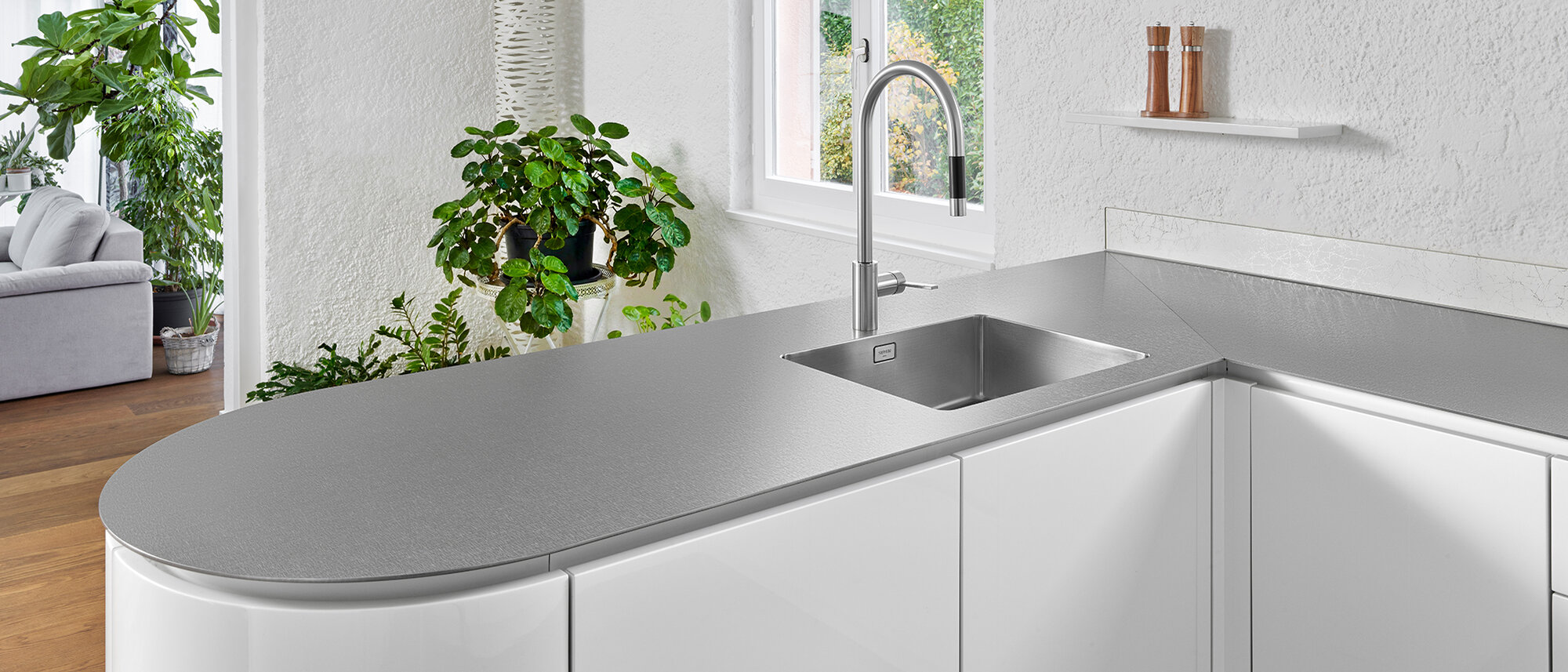
The stainless steel worktop follows the overall G-shaped construction of the kitchen, combining several functional areas into a cohesive whole. Long straight lines, changes of direction and the distinctive curve on the front edge work together. It is this transition that shows clearly that the worktop does not follow standard dimensions but is tailored to the individual geometry of the kitchen.
The stainless steel follows the contours of the furniture exactly and continues its style into the curve. This means the bespoke solution is not only a technical solution but a design element in itself. The worktop blends into the architecture rather than imposing limits on it.


Custom-made unique stainless steel products
From kitchen worktops with integrated water centres to back panels to sophisticated shapes – bespoke stainless steel products allow for unlimited design freedom when planning a kitchen. At the Suter Inox factory, we custom-make stainless steel components with the greatest precision and genuine passion. The result is inspiring functionality and enduring design.
Delicate lines, striking impact
What appears subtle at first glance unveils its true expressiveness in the light. The cross-sanding of the Xrange Fineline surface gives it a fine structure, with different reflective nuances emerging depending on the light. In the reduced colour scheme of white fronts and a dark wood floor, the cross-sanding gives the generous worktop depth.
The additional sTec coating assists in everyday life: It is water and dirt repellent and reduces fingerprints without visibly altering the look or feel of the surface.


Single unit rather than individual components
The calm design continues with the water centre. The Daneo range bowl is flush-welded into the stainless steel worktop, forming a single unit. This ensures the bowl remains clear and understated, while at the same time creating a hygienic, easy-to-clean transition.
The Tipo Desino overflow and drain technology follows this design concept. The stainless steel cover conceals the underlying basket, ensuring a calm look in the bowl. The drain is opened, closed and put in cleaning position by pressing the cover.



A bold statement in every curve
The visual understatement of the bowl and drain technology sets the scene for an element that acts as a confident counter-accent: the Dornbracht Tara Ultra faucet. Its size and distinctive bend give it a unique silhouette. At the same time, it is closely tied into the architecture of the space as the curved style of the worktop and the kitchen furniture is echoed on a smaller scale in the bend of the faucet. The faucet therefore continues the geometric theme uniting the kitchen as a whole.
The colour of the faucet is also true to the design. The platinum matte surface brings a subtle, warm metallic effect to the water centre, which corresponds to the tone of Xrange Fineline. A closeness arises without the faucet and worktop sharing the same look. Rather, they are two interpretations of the same material world and consistently continue the alternation of independence and combination.

Water centre
The water centre is one of the functional focus points of every kitchen. The interplay between the individual components is key, creating a work area with visual appeal that also supports the processes in the kitchen well.
Discover the products used and find out more about their design and function.


Complex concept
made simple
This kitchen shows the flexibility with which stainless steel can be adapted to an individual geometry. The actual scope starts here: with special shapes, unusual transitions and solutions that have no template. Because some ideas don’t need a standard design but a material that enables individual solutions.
And the most exciting shape is one that hasn’t been built yet.


